











Neonatal Infectious Diseases/Immunology 3: Evaluating and preventing infections in NICU
Session: Neonatal Infectious Diseases/Immunology 3: Evaluating and preventing infections in NICU

Karen D. Fairchild, MD
Professor of Pediatrics
University of Virginia School of Medicine
Earlysville, Virginia, United States
.jpg)
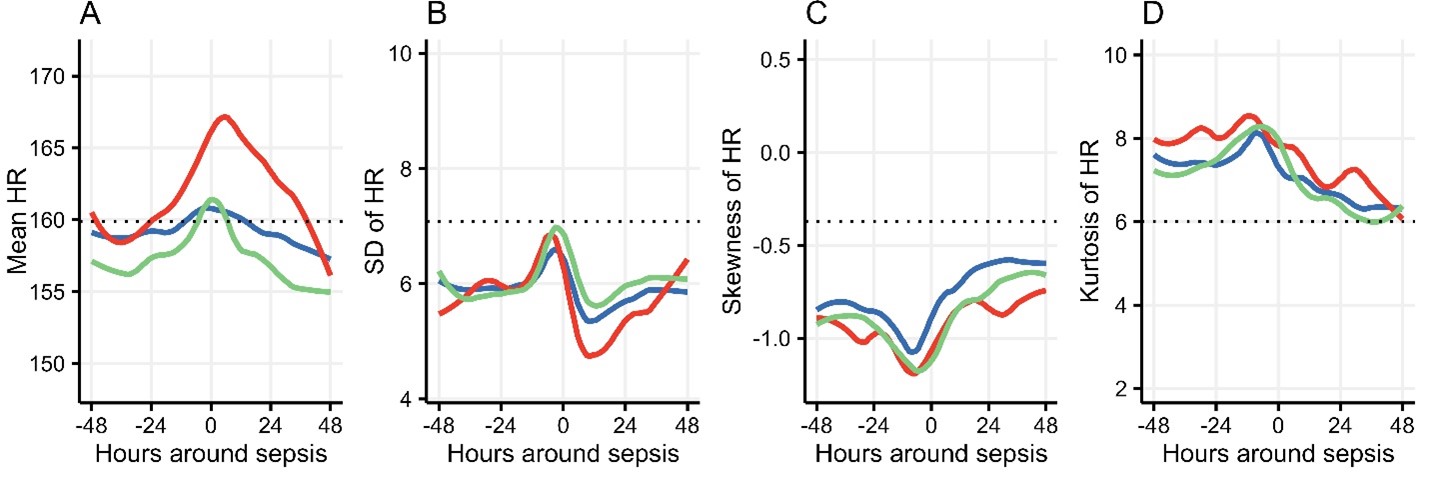 HR data were available for VLBW infants at 4 NICUs around the time of 369 sepsis events. Hourly group mean (A), standard deviation (B), skewness (C), and kurtosis (D) are shown for infants with GN LOS (red, n=79), CONS LOS (blue, n=222), and OGP LOS (green, n=68). The dashed horizontal line represents the mean heart rate characteristic for all VLBW infants at all times. Using sign rank tests, mean HR rose significantly by time zero (time of positive blood culture) compared to 24 hours prior for each group, with the earliest rise and highest peak for the GN group. Standard deviation of HR also increased prior to LOS diagnosis, mirrored by a decrease in skewness reflecting more transient decelerations. There was not a significant change in HR kurtosis around the time of LOS.
.jpg) Heart rate mean (A), standard deviation (B), skewness (C), and kurtosis (D) are shown for infants for infants that survived (blue, n =33) versus those that died within 7 days of LOS diagnosis (orange, n =336). Horizontal line in the box is median, box bounds are 25th and 75th percentile, whiskers are 5th and 95th percentile, and dots are outliers. Asterisks indicate HR SD and skewness were significantly higher in survivors (p < 0.05).
Heart rate mean (A), standard deviation (B), skewness (C), and kurtosis (D) are shown for infants for infants that survived (blue, n =33) versus those that died within 7 days of LOS diagnosis (orange, n =336). Horizontal line in the box is median, box bounds are 25th and 75th percentile, whiskers are 5th and 95th percentile, and dots are outliers. Asterisks indicate HR SD and skewness were significantly higher in survivors (p < 0.05).