Session: Developmental and Behavioral Pediatrics 3: Autism 1
785 - Cognitive Pretesting: An Approach to Address Autism Research Disparities Among Families with Limited English Proficiency
Saturday, April 26, 2025
2:30pm - 4:45pm HST
Publication Number: 785.4142
Danielle J. Abate, UMASS Chan Medical School, Worcester, MA, United States; Ava Lu, Oregon Health & Science University School of Medicine, Portland, OR, United States; Luis Rivas Vazquez, Oregon Health & Science University School of Medicine, Portland, OR, United States; Hao Tran, Doernbecher Children's Hospital at Oregon Health & Science University, Portland, OR, United States; Xihan Yang, University of Massachusetts Medical School, Shrewsbury, MA, United States; Camellia Tran, Doernbecher Children's Hospital at Oregon Health & Science University, Portland, OR, United States; Natacha Julceus Fabien, Fondation Luc Eucariste, Columbia, SC, United States; Kirsty V. Bernal, Children's Hospital pf Philadelphia, Philadelphia, PA, United States; Olivia Lindly, Northern Arizona University, Flagstaff, AZ, United States; Kate Wallis, Childrens Hospital of Philadelphia, PHILADELPHIA, PA, United States; Karen Kuhlthau, MassGeneral Hospital for Children, Boston, MA, United States; Katharine Zuckerman, Oregon Health & Science University School of Medicine, Portland, OR, United States; sarabeth broder-fingert, UMASS Medical School, Worcester, MA, United States
Clinical Research Assistant Oregon Health and Science University Portland, Oregon, United States
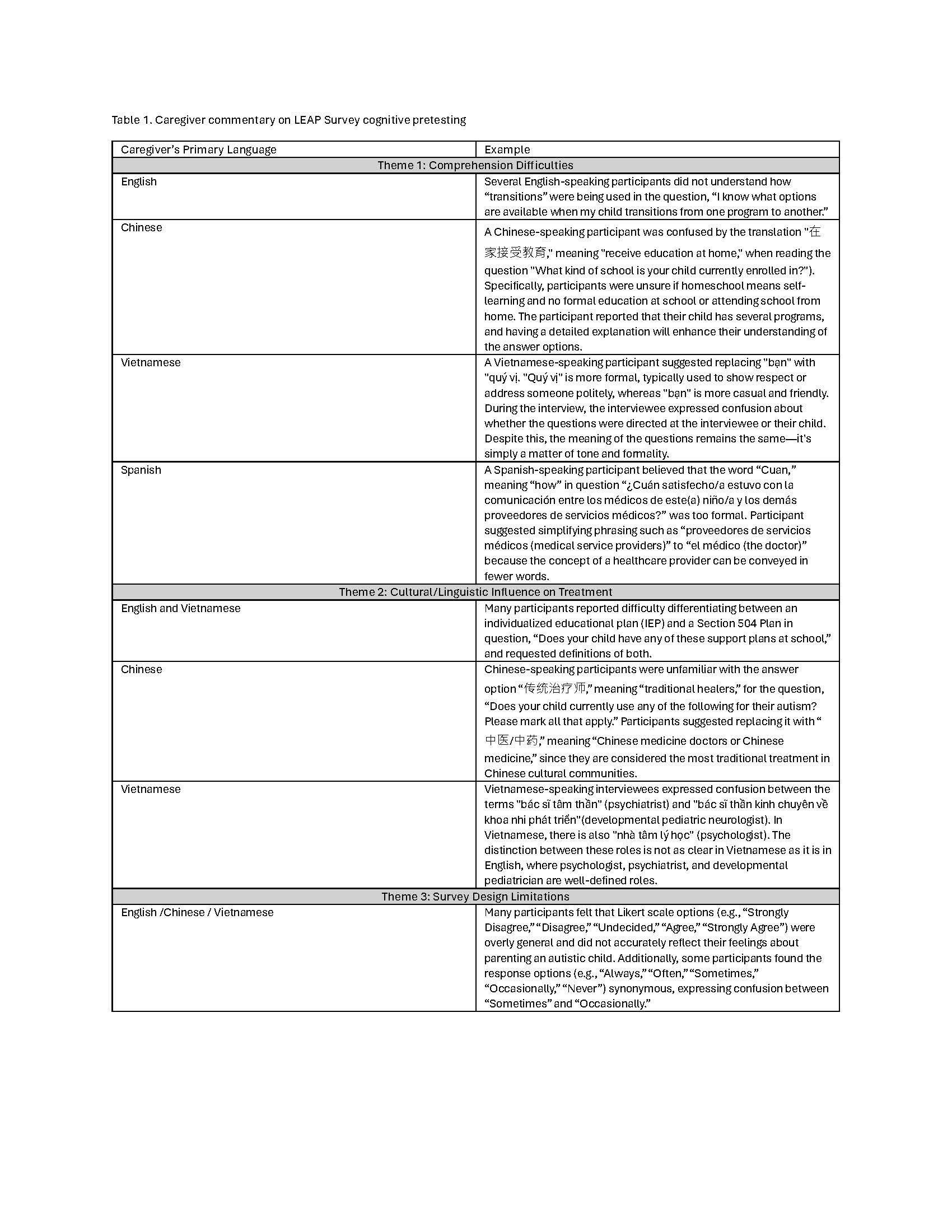
Background: Families who are dually impacted by autism spectrum disorder (ASD) and limited English proficiency (LEP) face substantial barriers to care yet have been systematically excluded from disparities research1-3. Very few parent-reported measures of ASD treatment mediators or outcomes have been validated in languages other than English or Spanish, with research illustrating that healthcare disparities may be greater for LEP families who do not speak either language4-6. To overcome these challenges in understanding the relationship between LEP status and service use disparities, we developed the Limited English Proficiency and Family Experiences with Autism Project (LEAP) Survey to validate measures of autism service utilization in five languages. Objective: The purpose of this study was to conduct cognitive pretesting of a preliminary draft of the LEAP Survey. Cognitive pretesting will identify elements of the LEAP Survey that impact its acceptability, accessibility, and understandability with English-speaking and LEP caregivers of autistic children. Design/Methods: 15 caregivers of autistic children aged 5-12 years were recruited from community organizations in Massachusetts and Oregon to complete cognitive pretesting in their primary language (Chinese (N = 3), English (N = 10), Haitian Kreyol, Spanish (N = 1), Vietnamese (N = 1)) via Zoom. Caregivers viewed each section of the LEAP survey and were instructed to utilize a think-aloud method7, where they read each survey item and were asked to both answer the question and to provide section-specific critiques. Caregiver feedback was documented and categorized according to whether they addressed survey phrasing, section-specific probing questions, or survey design. Results: Caregivers reported the following limitations with the preliminary LEAP Survey draft: (1) Comprehension difficulties due to the use of improper phrasing, tone, or sentence complexity in specific survey questions; (2) Cultural and linguistic influence on familiarity with autism services, medications, and providers; and (3) Design issues including repetitive response options for validated survey measures and a visually taxing layout. Table 1 depicts examples of caregiver feedback.
Conclusion(s): English-speaking and LEP caregivers of autistic children identified limitations of the initial LEAP Survey that impacted their ability to answer questions about their autism service utilization. Cognitive pretesting of the internet-based and telephone modalities of the LEAP Survey will be conducted to further revise the survey before it is piloted.
Table 1. Policy factors impacting inter-state variability in early autism diagnosis.
Table 1. Policy factors impacting inter-state variability in early autism diagnosis.