Session: Health Equity/Social Determinants of Health 5
711 - Disparities in Post-Injury Mental and Physical Healthcare in Seriously injured Children
Sunday, April 27, 2025
8:30am - 10:45am HST
Publication Number: 711.4284
Elizabeth J. Hisle-Gorman, Uniformed Services University of the Health Sciences F. Edward Hebert School of Medicine, Bethesda, MD, United States; Sarah Prabhakar, Uniformed Services University of the Health Sciences F. Edward Hebert School of Medicine, Bethesda, MD, United States; Ian S. Sorensen, Henry M Jackson Foundation for the Advancement of Military Medicine, Inc, Bethesda, MD, United States; Rebecca N. Schulz, Henry M. Jackson Foundation, Rockville, MD, United States; Siddarth Sharma, Uniformed Services University of the Health Sciences F. Edward Hebert School of Medicine, Bethesda, MD, United States; Kalyn C.. Jannace, Uniformed Services University of the Health Sciences F. Edward Hebert School of Medicine, Bethesda, MD, United States
Associate Professor Uniformed Services University Bethesda, Maryland, United States
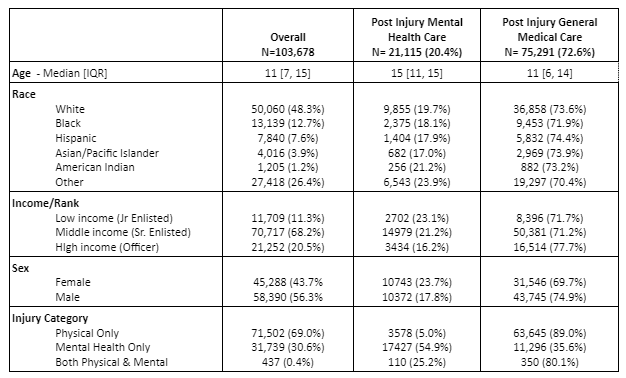
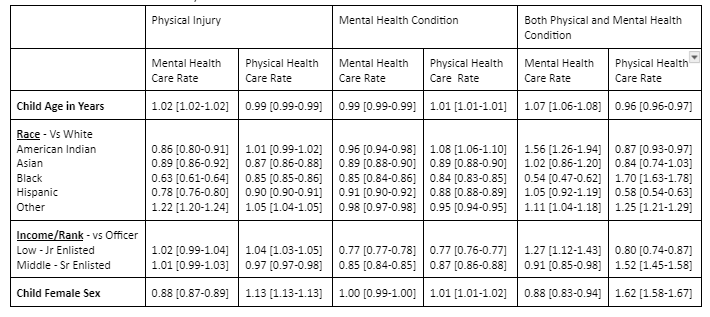
Background: Children from minority races and low income families are at increased risk of adversity, however health care disparities often result in lower care rates for these groups. Objective: To examine disparities in physical and mental health (MH) care utilization following serious injury in military connected children with universal health coverage. Design/Methods: We used Military Health System electronic health record data to examine post injury physical and MH care. Family race and rank (surrogate for income; Jr Enlisted indicates low income and Officer high income) was extracted from enrollment records. ICD codes identified children’s injuries from 2005-15, classified as physical (TBI, shrapnel, spinal cord, blindness, burns, severe fracture, amputation, and multiple significant trauma), MH (PTSD, and MH hospitalization) or both. Provider specialty type identified MH and physical healthcare. Poisson regression calculated visit rate ratios. Models were adjusted for age and sex, and stratified by injury type. Results: A total of 101,678 children with serious injury were identified. Children were more likely to have physical health care (72.6%) than MH care (20.4%) post injury; disparities in care existed by race, income, age, sex and injury type (Table 1). In children with physical injuries, decreased MH and physical care was associated with all non-White races except Other (missing, biracial and other races) which had increased mental health care and American Indian whose physical care rates didn’t differ. MH care did not differ by income and physical care increased with low income and decreased with middle income as compared to high. In children with MH injuries, decreased post-injury MH and physical care was associated with both lower income categories, and all non-White races, with the exception of increased physical health care associated with American Indian race. In children with both injury types, decreased MH care was only associated with Black race and middle income, and was not significantly different or increased with remaining races and income; decreased physical health was associated with American Indian and Hispanic race and low income and was increased with Black and Other race categories and middle income (Table 2).
Conclusion(s): In an equal access healthcare system non-White race and lower and middle income were generally, but not always, associated with decreased physical and MH care. Children with more severe need (both injury categories) tended to have decreased care in either MH or physical care, but not both.
Table 1: Percent of Children with any Post Injury Mental or Physical Health Care by Demographics
Table 2: Mental and Physical Health Care Rate Ratios