Session: Hospital Medicine 3: Systems/Population-based Research
149 - Rates of Declining to Answer Social Determinants of Health Screening Questions among Pediatric Patient Caregivers Vary By Sociodemographic Factors
Sunday, April 27, 2025
8:30am - 10:45am HST
Publication Number: 149.6272
Nathan Tran, University of California, San Francisco, School of Medicine, San Francisco, CA, United States; Emilia De Marchis, University of California, San Francisco, School of Medicine, San Francisco, CA, United States; Matthew S. Pantell, University of California, San Francisco, School of Medicine, San Francisco, CA, United States
Clinical Research Coordinator UCSF San Francisco, California, United States
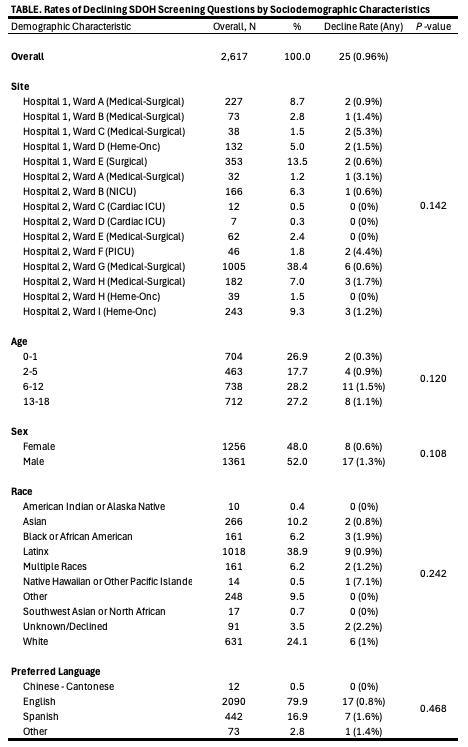
Background: Social risk factors - adverse social drivers (or determinants) of health (SDOH) – are associated with a variety of negative health outcomes among children. Consequently, standards setting organizations including the Joint Commission and National Committee for Quality Assurance have recommended screening hospitalized children for SDOH and providing resources to address social needs. While qualitative studies have generally shown caregiver acceptability of SDOH screening in the pediatric inpatient setting, little is known about how often caregivers decline to answer SDOH screening questions and how rates of declining vary by sociodemographic characteristics. Understanding which populations do not wish to answer SDOH screening questions can inform SDOH screening practices to make them more equitable and patient-centered. Objective: To determine how often patient caregivers decline to answer SDOH screening questions in the pediatric hospital setting, and how these decline rates vary by sociodemographic characteristics and SDOH domain. Design/Methods: We examined rates of declining to answer screening questions about the following SDOH domains among 15 pediatric hospital units across 2 children’s hospitals in Northern California: financial strain, food insecurity, housing instability, transportation needs, and utilities needs. We compared decline rates by patient age, sex, race, ethnicity, and preferred language using Chi-squared tests. We examined all encounters from Jan 1, 2024 to August 31, 2024, only including the initial hospitalization encounter for children hospitalized more than once. Results: The sociodemographic characteristics of our final analytic sample (N=2,617) can be found in the Table. 0.96% of caregivers declined answering at least 1 SDOH domain question, with 0.55% declining to answer questions about financial strain, 0.69% declining to answer about food insecurity, 0.21% declining to answer about transportation needs, 0% declining to answer about housing, and 0.98% declining to answer about utilities needs. While rates of declining to answer any SDOH domain question varied by sociodemographic characteristics, Chi-squared tests were not significant (Table).
Conclusion(s): In this study of 15 pediatric inpatient units at two hospitals over a 9-month period, there were low rates of declining to answer SDOH questions. While rates of declining varied by sociodemographic characteristics, these differences were not significant, although small rates of declining limited power. Future work should seek to understand reasons families declined to answer SDOH questions to improve the screening process.
TABLE. Rates of Declining SDOH Screening Questions by Sociodemographic Characteristics